
Doctoral Candidate 7
Mechanisms of HIV-induced neurodegeneration
About MERIT
MERIT (MEtabolic Reprogramming in viral pathogenesis: from Infection to Therapeutic innovations) is an EU-funded MSCA training programme aimed at better understanding how viruses affect the human body. Coordinated by Dr. Adithya Sridhar, Assistant Professor, and Prof. Dr. Dasja Pajkrt, Professor of Pediatric Infectious diseases, from the OrganoVIR Labs at Amsterdam UMC (location AMC), this project brings together 7 academic institutions and 12 associated partners from across Europe.
Within MERIT, researchers will take a new, holistic approach that focuses on infections and host metabolism to unravel virus-induced metabolic reprogramming and its impact on human health. The project’s objective lies in understanding the complex interplay between viruses and host cells, focusing on metabolic reprogramming, and long-term consequences of infection. This will be achieved by combining three methodological pillars: human organoids, integrative and spatial omics, and advanced microscopy.
Background of project
Despite effective combination antiretroviral therapy (cART), individuals living with HIV experience neurocognitive impairments, collectively known as HIV-associated neurocognitive disorders (HAND). The neuropathological changes observed in HAND are also found in neurodegenerative disorders (NDDs), such as Alzheimer’s disease, Amyotrophic Lateral Sclerosis, and Parkinson’s disease. A common link between HAND and NDDs is disrupted lipid metabolism, with HAND patients exhibiting increased amyloid-beta deposition. Clinical data suggest that TDP-43 proteinopathy may contribute to HAND, further linking it to NDDs. This project aims to explore these connections using iPSC-derived microglia-embedded brain organoids. By characterising lipid profile changes following HIV infections and investigating TDP-43 proteinopathy, we seek to identify potential mechanisms underlying HAND.
Job description
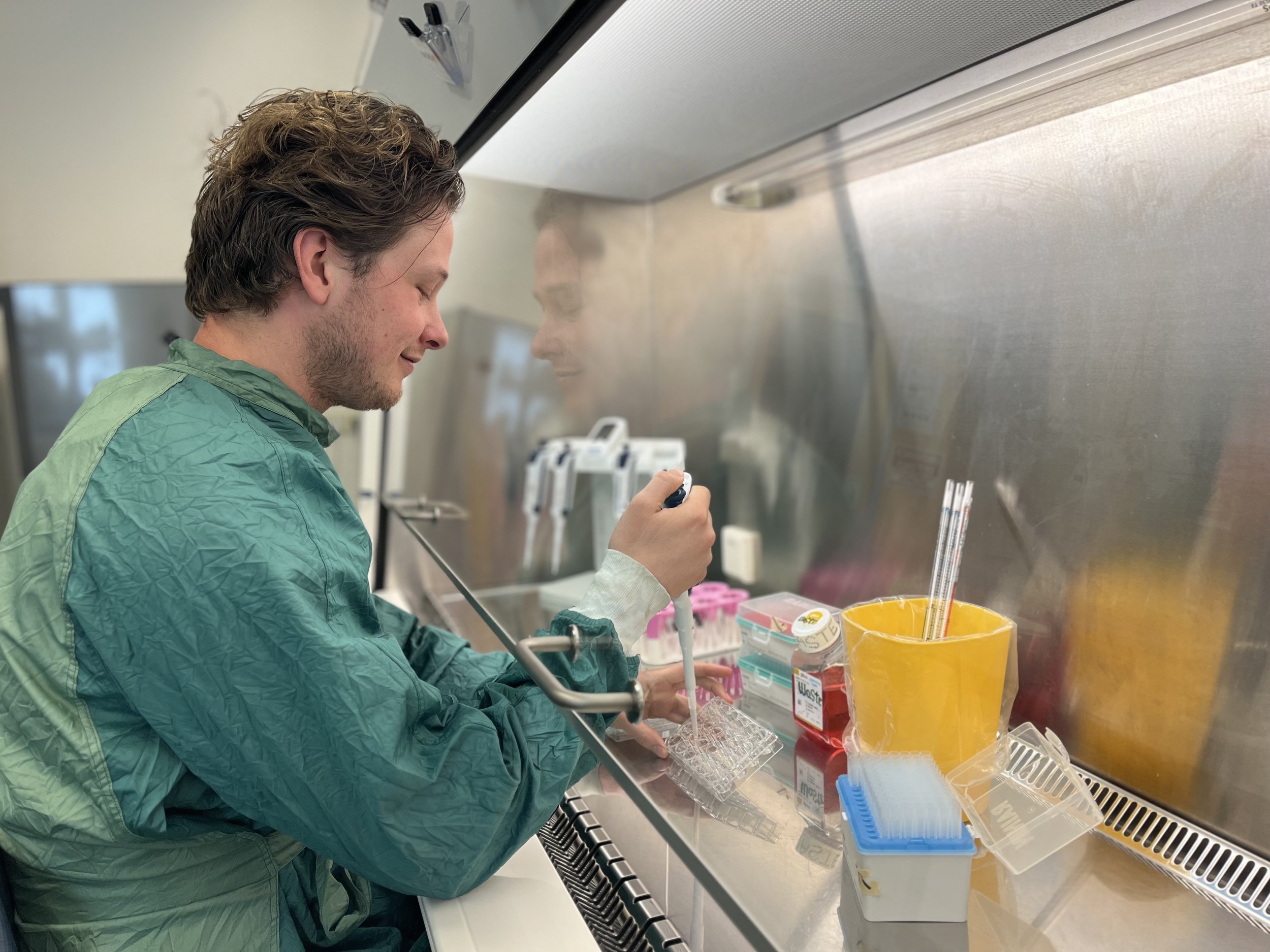
At the Amsterdam UMC in the Netherlands, MERIT is looking for a Doctoral Candidate (DC) to work on Work Packages 1 and 2. As DC7, your objectives are:
To characterise lipidomic profiles of HIV-infected brain organoids compared to healthy organoids
To assess and alter TDP-43 proteinopathy in HIV-infected organoids
You will be guided during your research project by Prof. Dr. Dasja Pajkrt and Dr. Renata Vieira de Sá at the OrganoVIR Labs at the Amsterdam UMC, Netherlands. You can apply for this position until 30 October 2026. Applications submitted after this date will not be considered.
Requirements
A motivated PhD candidate with an academic qualification (MSc or MD, or close to completion) in one of these disciplines: in (bio)medical sciences, biology, cell biology, biotechnology, or a closely related field and has a solid foundation in molecular and cellular biology as well as immunology
Expertise in one or more of the following fields: virology, (3D) cell culture, tissue engineering.
Experience with experimental laboratory techniques relevant to the field, strong analytical and problem-solving skills, and the ability to work both independently and collaboratively within a multidisciplinary research team.
Excellent oral and written communication skills in English (minimum C1/C2 CEFR level)
Have not resided/carried out work or studies in the Netherlands for more than 12 months in the 36 months immediately before 1 April 2027.
What we offer
A contract with Amsterdam UMC Research BV for 36 hours per week for 4 years (probation of 6 months).
The opportunity to work on large-scale and in-house research with motivated colleagues from all over the world.
Planned secondments in International Centre for Genetic Engineering and Biotechnology (ICGEB) & Leiden University Medical Center (LUMC).
Training in safety and biosecurity aligned with international best practices. You will be trained in hazard identification, containment, incident reporting, and dual-use/gain-of-function issues.
An opportunity to take part in a tailor-made pre-MBA programme to develop entrepreneurial and commercial skills and other network-wide training opportunities including conferences and courses, a Personal Development Plan, non-academic coaching, and workshops on topics including ethics and sustainability and AI/LLM.
Gross monthly salary ranging from €3,153 to €4,615 (in accordance with CAO-UMC, scale 10).
A holiday allowance of 8% and a year-end bonus of 8.3% of the gross annual salary.
100% reimbursement for public transport travel costs and, for private transport, €0.18 per km up to a maximum of 40 km each. Do you prefer walking or cycling? Take advantage of our good bike scheme.
About the host institution
The Amsterdam UMC, location AMC, houses the university hospital and the medical faculty of the University of Amsterdam, as well as several research institutes.
houses the university hospital and the medical faculty of the University of Amsterdam, as well as several research institutes.
The OrganoVIR Labs is uniquely embedded within both the Department of Medical Microbiology and Infection Prevention (MMI) and the Department of Pediatrics and is affiliated with the Amsterdam Immunity and Infection Institute (AIII), Amsterdam Reproduction and Development (AR&D), and Emma Centre for Personalized Medicine (Emma CPM). This multidisciplinary positioning fosters close collaboration between fundamental, translational, and clinical research.
OrganoVIR Labs has access to various advanced facilities including level 3, state-of-the-art molecular biology and culture facilities and access to high-throughput sequencing. Through its integration with the Department of Pediatrics, OrganoVIR Labs also benefits from extensive clinical expertise in the care of children with a broad spectrum of acute and chronic conditions. The department’s multidisciplinary approach and extensive clinical expertise support the translation of research findings into improved outcomes for pediatric patients.