
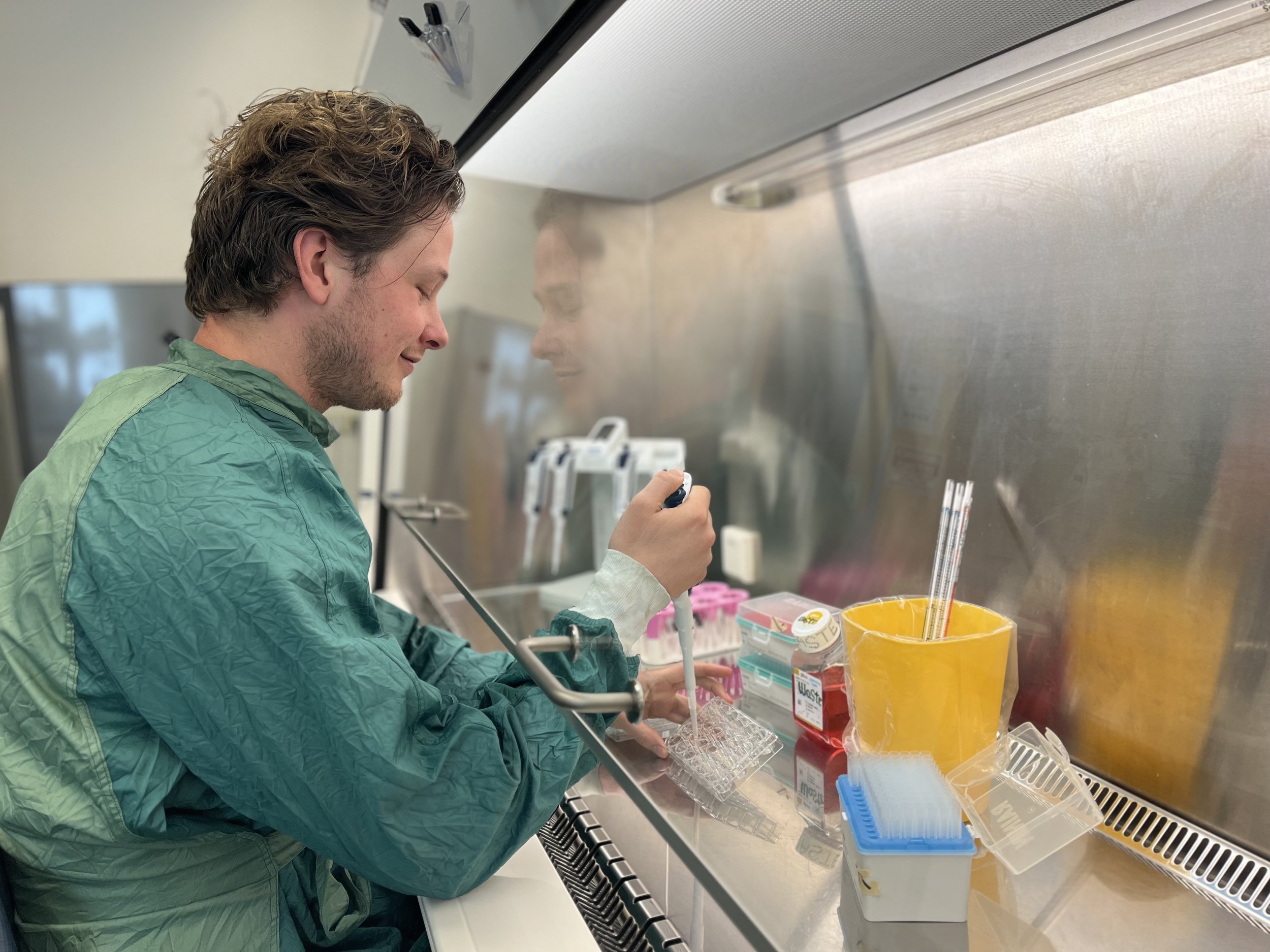
Doctoral candidate 3
Understanding long-term alterations in the central nervous system (CNS) following common cold coronavirus infections
About MERIT
MERIT (MEtabolic Reprogramming in viral pathogenesis: from Infection to Therapeutic innovations) is an EU-funded MSCA training programme aimed at better understanding how viruses affect the human body. Coordinated by Dr. Adithya Sridhar, Assistant Professor, and Prof. Dr. Dasja Pajkrt, Professor of Pediatric Infectious diseases, from the OrganoVIR Labs at Amsterdam UMC (location AMC), this project brings together 7 academic institutions and 12 associated partners from across Europe.
Within MERIT, researchers will take a new, holistic approach that focuses on infections and host metabolism to unravel virus-induced metabolic reprogramming and its impact on human health. The project’s objective lies in understanding the complex interplay between viruses and host cells, focusing on metabolic reprogramming, and long-term consequences of infection. This will be achieved by combining three methodological pillars: human organoids, integrative and spatial omics, and advanced microscopy.
Background of project
The potential link between viral exposures and neurodegenerative disease (NDD) risk has gained significant attention, particularly considering long-COVID. Recent studies have revealed a strong association between viral encephalitis and Alzheimer's disease, while viral pneumonia has been linked to at least five neurodegenerative diseases. Neuroimmune metabolism is believed to play a critical role in the long-term effects on the Central Nervous System (CNS). Although the focus has rightly been on SARS-CoV-2 and long-COVID, there is relatively little known about common cold coronaviruses and their effects on the CNS. This study aims to investigate the vulnerability of brain organoids to common cold coronavirus infections, examining their effects on cell survival, tissue metabolism, and potential links to psychiatric and neurodegenerative disorders.
Job description
At Jagiellonian University in Warsaw, Poland, MERIT is looking for a Doctoral Candidate (DC) to work on Work Packages 1 and 2. As DC4, your objectives are:
To assess the vulnerability of brain organoids to infection with common cold coronaviruses
To examine the role of infection on cell survival and tissue metabolism
To identify markers following infection that link to CNS insults, including psychiatric and neurodegenerative disorders
To test the effect of small molecular host inhibitors and combinatorial treatment on infections in the CNS.
You will be guided during your research project by Dr. Aleksandra Milewska and Prof. Krzysztof Pyrć. You can apply for this position until 30 October 2026. Applications submitted after this date will not be considered.
Requirements
Master's degree in biomedical sciences, infection, immunity or related fields
Experience working with mammalian cell culture, qPCR, and Bioinformatics are preferred.
Excellent oral and written communication skills in English (minimum C1/C2 CEFR level)
An interest in working in a multidisciplinary research group.
Have not resided/carried out work or studies in Poland for more than 12 months in the 36 months immediately before 1 April 2027.
What we offer
A contract with Jagiellonian University at Malopolska Centre of Biotechnology for 36 hours per week for 3 years (probation of 6 months).
The opportunity to work on large-scale and in-house research with motivated colleagues from all over the world.
Planned secondments in International Centre for Genetic Engineering & Biotechnology in Trieste Italy & Karolinska Institute in Stockholm, Sweden.
Training in safety and biosecurity aligned with international best practices. You will be trained in hazard identification, containment, incident reporting, and dual-use/gain-of-function issues.
An opportunity to take part in a tailor-made pre-MBA programme to develop entrepreneurial and commercial skills and other network-wide training opportunities including conferences and courses, a Personal Development Plan, non-academic coaching, and workshops on topics including ethics and sustainability and AI/LLM.
Gross monthly salary ranging from €1,876 to €2,288; mobility allowance: €710; family allowance (if applicable): €660.
Jubilee awards for long-term service ‒ in accordance with the Regulation for remuneration of employees of the Jagiellonian University; possible task-based and periodic allowances, as well as discretionary awards, upon meeting the conditions set out in the Regulation for remuneration of employees of the Jagiellonian University; additional annual remuneration, the so-called "thirteenth salary" ‒ after meeting the conditions specified in the relevant regulation.
Benefits: Institutional Social Benefits Fund (depending on the income per family member, in accordance with the Regulations for Granting Benefits from the Company Social Benefits Fund of the Jagiellonian University):
co-financing of summer holidays (PLN 1050–1550 gross) and winter holidays (PLN 700–900 gross);
co-financing for children for organised holidays (PLN 900–1400 gross), or co-financing of individually purchased summer camps, sports camps, winter camps, medical holidays or rehabilitation stays (50–90%, with the maximum amount eligible for co-financing being PLN 2500 gross) per child;
cash equivalent for a special occasional package of sweets in the amount of PLN 100–300 gross per child;
co-financing of childcare in nurseries, kindergartens and other forms of preschool education, as well as care provided by a daily guardian or nanny (PLN 250–400 gross).
About the host institution
Jagiellonian University is one of the oldest and most prestigious universities in Europe, with a strong tradition in biomedical sciences and international research excellence. The Małopolska Centre of Biotechnology is a leading interdisciplinary research institute of Jagiellonian University, bringing together experts in microbiology, virology, molecular biology, structural biology, bioinformatics, and biotechnology to address major challenges in human health.
The research team is embedded within Virogenetics – the Laboratory of Virology, one of Europe's leading academic virology laboratories, internationally recognized for its research on emerging viruses, particularly coronaviruses and other respiratory pathogens. The group combines expertise in virus biology, antiviral drug discovery, advanced human infection models, and translational virology, and has extensive experience coordinating large national and international research projects. Virogenetics maintains close collaborations with academic, clinical, and industrial partners, enabling rapid translation of fundamental discoveries into novel antiviral strategies and diagnostic solutions.
The laboratory collaborates closely with the Faculty of Biochemistry, Biophysics and Biotechnology, the Faculty of Medicine, and numerous national and international partners. This interdisciplinary environment promotes seamless integration of basic, translational, and applied research.